When Bending Isn't an Option
A telescoping coupling (also called a slip fix or repair coupling) is designed for situations where you can't bend the pipe to make a connection. Unlike standard couplings that require you to flex the pipe for clearance, a telescoping coupling slides and extends to bridge the gap between two fixed pipe ends.
- Tight Spaces: Perfect when pipes are against walls, foundations, or other obstacles
- No Bending Required: The coupling does the work - just slide and cement
- Professional Quality: Creates a permanent, cemented joint
- Controlled Environment: Ideal for exposed pipes in basements, crawl spaces, or utility rooms
Tools Needed
- PVC pipe cutter or hacksaw
- Measuring tape
- Marker or pencil
- Shovel (for buried pipes)
- Rag or towel
Shop Lowe's Collection
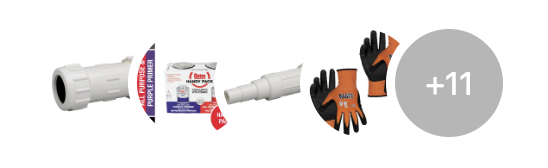 Shop All Parts at Lowe's
As a Lowe's affiliate, I earn from qualifying purchases. This does not affect your price.
Video Tutorial
Watch me demonstrate how to use a telescoping coupling for a strong, leak-free PVC pipe repair.
How Telescoping Couplings Work
A telescoping coupling has a unique design that allows it to extend and contract:
- Two-Piece Design: One section slides inside the other, allowing the coupling to extend
- Extended Installation: Slide one end fully onto a pipe, position the other end, then slide back to connect
- Cement Bond: Once in position, PVC cement creates a permanent chemical weld on both ends
- Full Strength: When cured, the joint is as strong as the original pipe
The "telescoping" action eliminates the need to bend or flex the existing pipes - you simply slide the coupling into place.
Size Matters!
Telescoping couplings come in specific sizes and have a limited extension range. Measure your gap carefully and check the coupling's specifications. Most residential couplings extend 2-4 inches. If your gap is larger, you may need to add a pipe section.
1 Assess the Repair Area
Before starting, evaluate your situation:
- Can you bend the pipe? If yes, standard couplings are cheaper
- Is the pipe against a wall or fixed in place? Telescoping is the answer
- Measure the gap you need to bridge
- Ensure pipes are dry - cement won't bond to wet surfaces
When to Use Telescoping
Telescoping couplings cost more than standard couplings. Use them when you genuinely can't bend the pipe - like repairs against foundations, in crawl spaces, or in rigid pipe runs.
2 Cut Out the Damaged Section
- Mark your cut lines on either side of the damage
- Use a PVC pipe cutter for the cleanest cuts (hacksaw works too)
- Make cuts as straight and square as possible
- Remove any burrs from the cut edges
- Clean the pipe ends of dirt and debris
Check the Gap
Measure the gap between your cut pipe ends. Your telescoping coupling needs to extend far enough to bridge this gap while still having enough insertion depth on each end for a strong bond.
3 Dry-Fit the Coupling
Before using any cement, test the fit:
- Fully compress the telescoping coupling
- Slide one end completely onto one pipe
- Position the coupling over the other pipe end
- Extend (slide) the coupling to connect both pipes
- Check that there's adequate insertion depth on both ends
If the gap is too large for the coupling's extension range, you'll need to add a replacement pipe section.
4 Apply Primer and Cement
Work systematically - one connection at a time:
- Apply purple primer to the first pipe end and inside the coupling
- Apply PVC cement generously to both primed surfaces
- Immediately slide the coupling fully onto the first pipe
- Give it a quarter turn to spread the cement
- Hold for 30 seconds
One Side First
Let the first connection set for a minute or two before cementing the second side. This gives you a stable base to work from.
5 Complete the Connection
- Apply primer to the second pipe end and the other end of the coupling
- Apply cement to both surfaces
- Slide (extend) the coupling over the second pipe
- Push firmly and give a quarter turn
- Hold for 30 seconds
- Wipe away any excess cement
Work Fast on the Second Joint!
The cement sets quickly. Have everything ready and make sure the coupling slides smoothly before applying cement. Once cement is on, you have seconds to make the connection.
6 Cure and Test
Allow proper cure time before putting the system back into service:
- Initial set: 2 minutes - don't move or stress the joints
- Handling: 15-30 minutes
- Pressure test: Wait at least 2 hours for irrigation pressure
- Best practice: 24 hours for full cure and maximum strength
Turn on water slowly and inspect the coupling at both ends for any leaks.
Telescoping vs. Other Repair Methods
Telescoping Coupling
- Best for: Tight spaces, fixed pipes, no-bend situations
- Pros: No pipe flexing needed, permanent cement bond
- Cons: More expensive, limited extension range
Standard Couplings (Bend Method)
- Best for: Open areas where pipe can flex
- Pros: Cheapest option, widely available
- Cons: Requires bending the pipe for installation
Compression Coupling
- Best for: Quick repairs, wet conditions
- Pros: No cement needed, instant use
- Cons: Mechanical seal (not as permanent), higher cost
Common Mistakes to Avoid
- Not dry-fitting: Always test the extension range before cementing
- Wet pipes: Cement won't bond to wet surfaces - dry everything first
- Skipping primer: Primer is essential for a proper chemical weld
- Insufficient cement: Apply a generous, even coat to all bonding surfaces
- Rushing: Don't try to cement both ends at once - do one side first
- Wrong size: Measure carefully - telescoping couplings must match your pipe diameter exactly
- Gap too large: If the coupling can't bridge the gap, add a pipe section
Get Your Supplies at Lowe's
Telescoping couplings, PVC cement, primer, and all the supplies you need for a professional repair.
Shop PVC Pipe Repair Collection
As a Lowe's affiliate, I earn from qualifying purchases. Prices and availability may vary.